



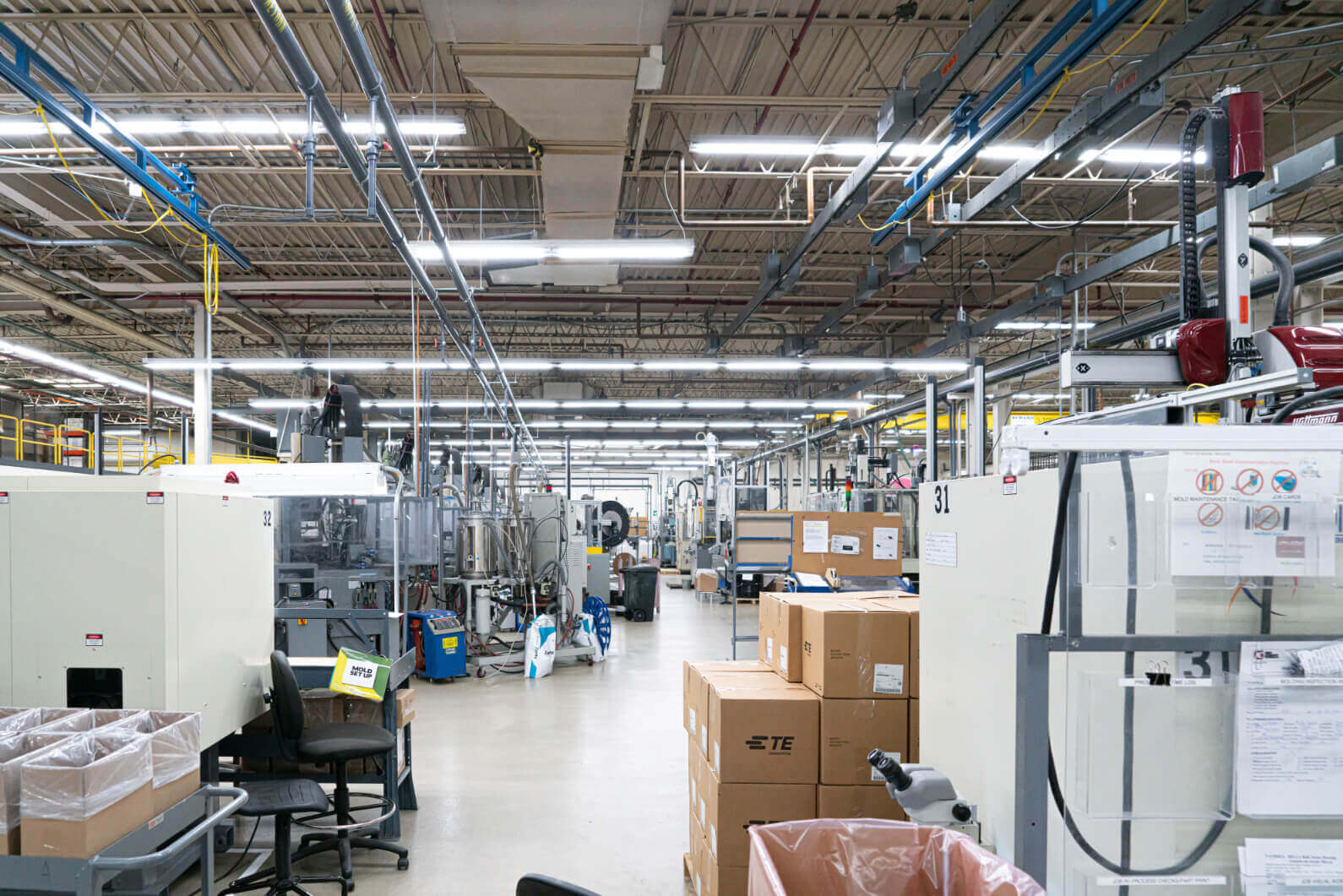
Insert molding bonds metal and plastic into a single component during one molding cycle. A stamped metal part is placed into the mold cavity, plastic is injected around it, and the part exits as a fully integrated metal-and-plastic assembly. In a turnkey manufacturing environment, insert molding eliminates one of the most failure-prone handoffs in the supply chain: the interface between the stamped contact and the plastic housing that holds it. When the same supplier stamps the metal, molds the plastic, and runs the insert cell, the metal-and-plastic interface stops being a coordination problem and becomes a single engineered process.
An automotive Tier 1 supplier reviews warranty data on an infotainment connector six months after launch. Field returns are higher than expected, and the failure mode is consistent: intermittent signal loss traced to micro-movement between the contact pin and the plastic housing. The contact passes pull-out testing. The housing passes dimensional inspection. The assembly meets the print. The part still fails in the field, in vehicles, under thermal cycling that the bench test never replicated. Root cause review eventually finds that the contact and the housing were specified by different engineering teams, manufactured by different vendors, and assembled mechanically rather than insert molded. The two parts fit together. They do not behave together.
This is the failure mode insert molding was developed to eliminate. By combining a metal component and the plastic that surrounds it into one molded operation, insert molding produces a single integrated part with a metal-to-plastic bond that does not depend on mechanical fit, adhesives, or post-assembly press fits. In a turnkey environment where the same supplier handles tool design, stamping, molding, and assembly, insert molding is the linchpin technology that lets metal and plastic components be designed, produced, and validated as one engineered system. This article walks through how insert molding actually works, why it is increasingly central to connector, electronics, and medical device manufacturing, and what changes when the entire process lives inside one facility.
What is insert molding, and how does it differ from regular injection molding?
Insert molding is an injection molding process where a pre-formed component, usually a metal stamping or machined part, is placed into the mold cavity before the plastic is injected. The plastic flows around the insert and bonds to it during cooling, producing a single finished part with the metal element fully encapsulated or partially exposed depending on the design. The cycle produces one integrated component instead of two separate parts that get assembled later.
Standard injection molding produces a plastic part with no embedded components. Any metal feature, such as a threaded brass insert, contact pin, or shaft, has to be added through a secondary process: ultrasonic insertion, heat staking, press fitting, or mechanical assembly. Each of those secondary processes introduces variation, takes additional cycle time, and creates an interface between the metal and plastic that depends on mechanical retention rather than a molded bond.
Insert molding eliminates that secondary process. The metal-to-plastic interface is created during the molding cycle itself, with plastic flowing into the surface texture of the insert and locking around its features. The result is a more robust bond, a tighter dimensional relationship between the metal and plastic, and a part that is ready to ship the moment it leaves the mold. New Concept Technology’s insert molding capabilities use six-axis robotics with laser displacement technology to place metal components into the cavity with the precision required for high-volume connector and medical device work.
Insert molding produces a finished metal-and-plastic component in one molding cycle, eliminating the secondary assembly steps and interface variation that come with separately produced parts.
Why does insert molding matter for turnkey manufacturing?
Turnkey manufacturing only delivers its quality and lead-time advantages when the steps are actually integrated. A supplier that stamps metal in one facility, molds plastic in another, and ships both to a third facility for assembly is not running an integrated process. The handoffs are still there. The accountability is still split. Insert molding is one of the technologies that makes true integration possible because it physically combines two of those steps into one.
When the metal stamping comes off the press, moves to the insert molding cell, and exits as a finished plastic-encapsulated component, several entire categories of risk disappear. There is no separate molded housing waiting in inventory. There is no mechanical assembly cell where the contact and the housing get joined. There is no warranty exposure from a metal-to-plastic interface that depends on press fit or adhesive bond. The metal and plastic are bonded during the molding cycle and stay bonded for the life of the part.
There is also a coordination dimension. Insert molding requires that the metal stamping and the plastic mold be designed together. The insert’s geometry has to fit the cavity precisely, the plastic flow has to wet the metal evenly without short-shooting or causing distortion, and the part has to release from the mold cleanly. In a multi-vendor environment, those decisions get negotiated across organizational boundaries, often after problems emerge in production. In a turnkey environment, the engineers who designed the stamping work in the same facility as the engineers who designed the mold. That coordination is built in from kickoff.
How does the insert molding process actually work?
The mechanics of insert molding are conceptually simple but operationally demanding. The cycle has four basic phases.
Insert preparation
The metal component, usually a stamping but sometimes a machined part or a wire form, is presented to the molding cell in a controlled orientation. For high-volume work, this typically means parts arrive on a strip carrier from a stamping press, oriented and indexed for robotic pickup.
Insert placement
A robotic arm picks the insert and places it in the mold cavity. Placement accuracy is critical because any misalignment translates directly into dimensional error on the finished part. Modern cells use laser displacement, machine vision, or both to verify position before the mold closes.
Plastic injection
The mold closes around the insert and plastic is injected at high pressure. Flow paths have to be designed so that the plastic wets the metal uniformly without creating excessive pressure that distorts the insert or scrubs against it during fill. Material selection matters: some plastics adhere mechanically to surface texture, while others form a chemical bond at the interface.
Cooling and ejection
The mold cools, the plastic solidifies around the insert, and the finished part is ejected. Differential thermal expansion between the metal and the plastic has to be managed during cooling, otherwise the part can develop residual stress that shows up as cracking or interface failure later.
Where does reel-to-reel insert molding fit?
Reel-to-reel insert molding is the high-volume version of the process and the technology that makes integrated stamping-and-molding economically viable for connector production. Instead of presenting individual stampings to the molding cell, reel-to-reel insert molding pulls a continuous strip of stamped parts through the cell on a moving carrier. Each cycle of the press handles multiple parts simultaneously, with the strip indexing through the cavity at production speed.
The advantages compound. Cycle times come down because there is no individual placement step. Dimensional repeatability improves because the strip holds parts in known positions. Material handling cost drops because the strip is the carrier from press to mold to downstream processes. And the entire flow can be set up so the metal never leaves the strip until after the plastic encapsulation is complete.
For high-volume connector programs, reel-to-reel insert molding is what allows the metal-and-plastic component to be produced at the cost and consistency that the industry demands. It is also a capability that very few molders offer, because it requires both the stamping side and the molding side to be operationally aligned at a level that is uncommon outside integrated suppliers.
What industries use insert molding most heavily?
Insert molding shows up across most industries that combine electrical and mechanical functions in compact assemblies. The four where it is most concentrated:
| Industry | Common Insert Molded Components | Why It Matters |
|---|---|---|
| Automotive | Connector housings with integrated contacts, sensor bodies, infotainment connectors | Vibration resistance and thermal cycling reliability over vehicle lifetime |
| Medical devices | Disposable surgical components, drug delivery housings, electrosurgical contacts | Sterilization compatibility, biocompatibility, single-use cost economics |
| Electronics and datacom | High-speed connector housings, leadframe-based packages, RF components | Density, signal integrity, miniaturization for next-generation devices |
| Consumer products | Tool handles with metal shafts, threaded inserts in housings, encapsulated electronics | Durability, cost reduction by combining parts, finished-look ergonomics |
In medical device work specifically, insert molding has become essential because the move toward disposable surgical instruments has driven volumes high enough to make the upfront tooling investment economical. Cleanroom-compatible insert molding cells, often running in ISO 14644-1 Class 6 or better environments, produce single-use components at the cost points the market demands. New Concept Technology operates a Class 6 cleanroom for medical molding work, with computer simulation of plastic flow used to optimize repeatability before tooling is cut.
Why do most teams underestimate the integration requirement?
If insert molding is so well-suited to integrated manufacturing, why do many programs still source the stamping and the molding from separate vendors and assemble them downstream? Three patterns repeat across our work with engineering and procurement teams.
The first is that insert molding looks expensive in isolation. The tooling is more complex than a standard injection mold, the cycle requires automation, and the per-cycle cost can be higher than running stamping and molding separately. What the unit-cost comparison misses is the elimination of the downstream assembly step, the secondary handling, the inventory of separate components, and the warranty exposure from mechanical-fit interfaces. The total program cost for an insert molded part is typically lower than the sum of stamping plus molding plus assembly, but only if the comparison is run end-to-end.
Assume a connector assembly running at 4 million parts per year. Stamping plus standard molding plus mechanical assembly might quote at a combined unit cost similar to insert molding. The integrated insert molded version typically removes the assembly step entirely, eliminates an inventory location, and reduces field warranty exposure. In our experience, the total program cost runs 10 to 25 percent lower for insert molded parts when assembly, inventory, and warranty are included. Numbers are illustrative; actual savings depend heavily on assembly complexity, volume, and warranty risk profile.
The second is that integrated insert molding capability is rare. Most plastic molders do not stamp metal. Most metal stampers do not mold plastic. The suppliers that can do both are a small subset of the contract manufacturing market, and many engineering teams do not realize the option exists. They specify the parts as separate and source them as separate because that is how the available supplier base is structured.
The third is design momentum. Once a connector or device has been designed as separate metal and plastic components, redesigning it as an insert molded assembly requires engineering effort upfront. Teams under release pressure rarely take that effort on, even when the long-term savings are substantial. The decision point matters most early in the design cycle.
How should engineering teams evaluate an insert molding partner?
Most molders can claim some insert molding capability, but the criteria that actually predict success on a precision program are narrower than the marketing suggests. The questions that matter:
- In-house tool design and build, so the mold gets designed alongside the insert rather than as a separate procurement.
- In-house stamping or proven coordination with a stamping partner inside the same organization.
- Reel-to-reel insert molding capability for high-volume connector and leadframe applications.
- Cleanroom molding for medical, optical, or contamination-sensitive work, with documented certification levels.
- Plastic flow simulation and design-for-manufacturability review during quoting, not just at production start.
- Robotic insert placement with verified position feedback, not blind pickup or manual loading.
- Quality systems that span stamping and molding rather than running separately for each process.
A supplier that meets all seven criteria is operating at the level required for serious connector and medical device work. New Concept Technology’s integrated capabilities were structured around this list, with stamping, molding, insert molding, tool fabrication, and assembly running under one engineering organization.
Frequently Asked Questions
Insert molding is an injection molding process where a pre-formed component, usually metal, is placed into the mold cavity and encapsulated by plastic during the molding cycle. The result is a single integrated part with a molded bond between the metal and plastic, eliminating the need for a separate assembly step. Common applications include connector contacts in plastic housings, threaded inserts in plastic components, and metal shafts encased in molded handles.
On the metal side, brass, copper alloys, stainless steel, mild steel, and aluminum are all common. On the plastic side, engineering thermoplastics including nylon, PBT, polycarbonate, polypropylene, LCP, and high-temperature polymers all work. Material compatibility, especially differential thermal expansion, has to be considered during design to avoid interface stress.
The terms overlap and are sometimes used interchangeably. Insert molding typically refers to molding plastic around a pre-formed component such as a metal stamping. Overmolding usually refers to molding one plastic over a previously molded plastic part, often a softer material over a rigid substrate. Both processes use similar tooling and machine setups, but the materials and applications differ.
Reel-to-reel insert molding processes stamped parts that remain on a continuous metal strip throughout the molding cycle. The strip indexes through the molding cell at production speed, with each cycle handling multiple parts simultaneously. This approach is the dominant method for high-volume connector production because it integrates stamping and molding into one continuous flow without individual part handling.
Insert molding tooling is more expensive than standard injection molding tooling, and the automation required for reliable insert placement adds further upfront cost. The economics generally favor higher volumes, where the per-part savings from eliminating downstream assembly and inventory pay back the tooling investment. For very low-volume work, mechanical assembly is often more economical. For medium to high volumes, insert molding usually wins on total program cost.
Automotive electronics, medical devices, telecommunications, datacom, consumer electronics, and industrial controls are the largest users. Within those industries, the most common applications are connector housings with integrated contacts, sensor bodies, drug delivery components, threaded inserts in structural plastics, and any part where a metal-and-plastic interface is critical to function.
Yes, with the right facility. Medical insert molding requires cleanroom-compatible cells, typically ISO 14644-1 Class 6 or better, biocompatible plastic resins, validated processes, and quality systems compliant with ISO 13485 and FDA expectations. Suppliers serving the medical device market typically operate dedicated cleanroom molding areas separate from their general industrial work.
New Concept Technology has built single-source insert molding capability spanning tool design, stamping, conventional and reel-to-reel molding, and assembly under one roof.
Contact Us →Sources
| Society of Plastics Engineers | Plastics Engineering Industry Resources |
| Plastics Industry Association | Manufacturing and Materials Standards |
| IATF Global Oversight | IATF 16949 Automotive Quality Management Standard |
| International Organization for Standardization | ISO 13485 Medical Devices Quality Management |
| Society of Manufacturing Engineers | Manufacturing Knowledge Base |