


MENU

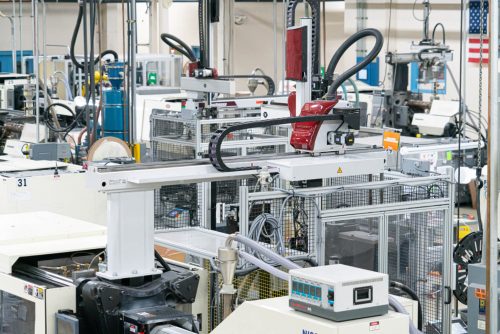
In advanced manufacturing, performance is no longer optional. It is expected. Components must withstand stress, vibration, thermal cycling, and continuous use while maintaining dimensional accuracy. This is where precision injection molding and injection molding inserts become essential.
Injection molding inserts are metal components integrated directly into a molded plastic part during the injection process. Instead of attaching hardware after molding, the insert becomes permanently encapsulated within the component. The result is a unified structure that combines the strength and conductivity of metal with the versatility and efficiency of engineered plastics.
At New Concept Technology, injection molding inserts are part of a fully integrated manufacturing approach. As a single-source partner providing design engineering, tool fabrication, molding, automation, and assembly, we ensure that injection molding inserts meet strict performance requirements while reducing production complexity.
High-performance components require more than basic molding. They demand reinforcement, reliability, and repeatability. Injection molding inserts enhance performance in several critical ways.
First, they provide localized structural strength. Instead of manufacturing an entire component from metal, engineers reinforce only the areas that require durability. This allows for lighter, more cost-effective designs without sacrificing mechanical integrity.
Second, injection molding inserts support electrical and thermal performance. In many applications, the insert functions as a conductive terminal, grounding feature, or heat-dissipation element, while the surrounding plastic provides insulation and environmental protection. This dual-material integration is particularly valuable in automotive, electronics, and medical device manufacturing.
Finally, injection molding inserts reduce assembly steps. Traditional manufacturing may require separate molding and fastening operations. Insert molding eliminates that secondary process, decreasing labor costs, minimizing error risk, and improving production speed.
The effectiveness of injection molding inserts depends on precision. The process begins with accurate insert placement inside the mold cavity. Once positioned, molten plastic is injected around the insert, bonding to it as it cools and solidifies.
Consistency in placement is critical. Even minor misalignment can compromise strength or functionality. That is why automation plays such an important role in modern insert molding operations.
New Concept Technology integrates advanced automation and robotic systems into injection molding inserts production to ensure repeatable accuracy and scalable efficiency. By controlling insert positioning, mold flow, and cycle timing, we maintain tight tolerances across high-volume runs.
Designing injection molding inserts requires collaboration between engineering and tooling teams. Material compatibility, thermal expansion, and mechanical retention features must be carefully evaluated to ensure long-term durability.
Insert materials commonly include stainless steel, brass, and copper alloys, selected based on strength and conductivity requirements. Plastic resin selection is equally important, as bonding performance depends on flow characteristics and thermal behavior.
Because New Concept Technology fabricates tools in-house, we optimize mold design and insert geometry simultaneously. This integrated design-to-manufacturing approach reduces development timelines while improving product reliability.
Injection molding inserts are widely used in industries where failure is not an option.
In medical device manufacturing, precision and compliance are paramount. Injection molding inserts are often found in diagnostic equipment, surgical tools, and cable assemblies. New Concept Technology supports medical manufacturers with ISO-certified environments and advanced molding capabilities that meet stringent quality standards.
In automotive systems, injection molding inserts reinforce connectors, control modules, and sensor housings. These components must withstand vibration, heat, and environmental exposure while maintaining electrical reliability.
Aerospace and defense applications rely on injection molding inserts to achieve high strength-to-weight ratios. Industrial and electronic manufacturing sectors depend on insert molding for datacom connectors and ruggedized enclosures.
Across these markets, injection molding inserts enable engineers to design smarter, stronger components without adding unnecessary weight or cost.
When comparing injection molding inserts to post-mold fastening methods, the benefits become clear. Injection molding inserts offer several measurable advantages:
By integrating reinforcement directly into the molding cycle, manufacturers eliminate secondary assembly steps and improve overall production efficiency.
As manufacturing shifts toward greater automation and onshore production strategies, injection molding inserts continue to evolve. Robotics, digital inspection systems, and real-time process monitoring improve quality and reduce labor dependence.
New Concept Technology’s comprehensive automation and manufacturing services support cost-stabilized, high-volume insert molding production. By combining injection molding inserts with integrated assembly and quality control systems, we help customers streamline their supply chains while maintaining superior performance standards.
Emerging trends such as micro-insert molding, multi-shot molding integration, and enhanced traceability are expanding the capabilities of injection molding inserts. These advancements allow manufacturers to meet increasing demands for compact, high-density electronic and medical components.
Managing design, tooling, molding, and assembly across multiple vendors introduces unnecessary risk. Delays, communication gaps, and inconsistent quality can impact product performance and time-to-market.
Working with a single-source partner ensures injection molding inserts are engineered, manufactured, and validated within a unified system. New Concept Technology provides an integrated ecosystem from concept development and tool fabrication to automated molding and final assembly.
Our commitment to quality, accountability, and continuous improvement ensures that injection molding inserts not only meet specifications but also exceed expectations.

Injection molding inserts are fundamental to high-performance component manufacturing. By combining metal reinforcement with engineered plastics in a single operation, manufacturers achieve greater strength, improved conductivity, reduced assembly time, and optimized weight.
As industries continue demanding more from their components, precision injection molding and injection molding inserts will remain a strategic solution for durability, efficiency, and innovation. Partnering with an experienced, fully integrated manufacturer ensures your injection molding inserts deliver consistent performance from prototype to full-scale production.