
MENU

When introducing a new or improved medical device to the market, high-volume product development can help businesses enjoy various benefits, from cost savings to consistent quality to enhanced market reach. Producing medical devices at scale can ultimately support improved patient outcomes and help your company bring greater value to the medical industry through advanced medical device manufacturing capabilities.
Explore the essential role of high-volume manufacturing, the basic stages of product development and why working with a trusted, experienced manufacturing partner is key to streamlining the process in this guide.
Precise, high-volume manufacturing is crucial for the advanced development of health solutions and medical devices. It helps businesses continuously upgrade their device designs and revolutionize how their products work.
Below are key reasons for choosing this type of manufacturing.
The global demand for medical devices is increasing. Factors such as growing healthcare access and robust technological advancements are driving this market expansion. High-volume manufacturing helps companies meet demand by:
Medical device businesses must balance costs and quality. High-volume product development supports greater cost-effectiveness in several ways:
The reduced costs associated with high-volume manufacturing enable widespread access to innovative medical device technologies.
Manufacturers are able to recoup their investments relating to research and development (R&D) more quickly when they can accommodate high-volume sales. Lower manufacturing costs make advanced devices more available and affordable to a wider range of patients, encouraging broader adoption of new medical technologies.
Maintaining consistent quality is crucial in medical device manufacturing because the performance of products can directly influence patient outcomes. High-volume manufacturing can improve quality by establishing standardized processes that reduce variability and help support more consistent device results.
The data collected from high-volume production can be advantageous in proactively identifying and addressing quality-related issues, such as material defects or temperature variations during the molding process.
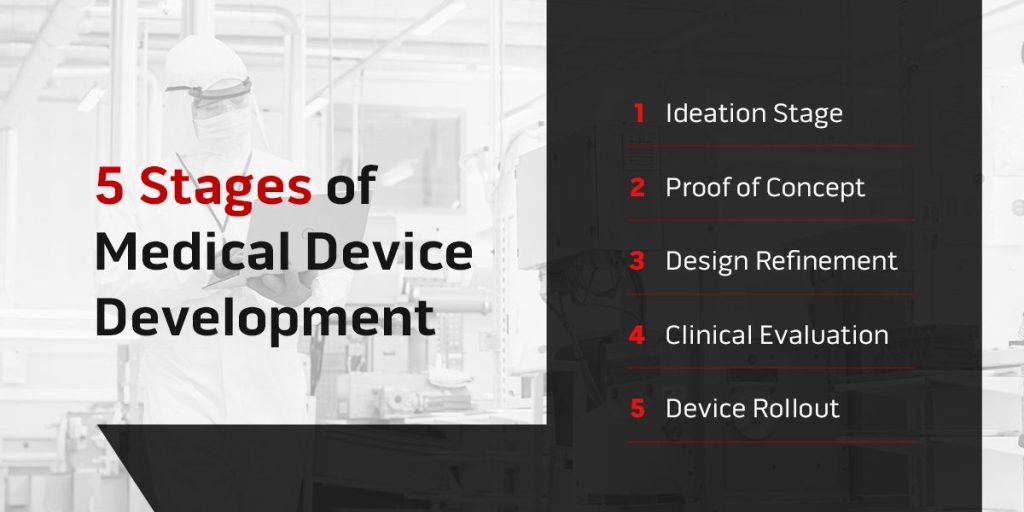
High-volume product development requires careful planning to meet precise design specifications and optimize manufacturing processes. Explore more about each step of the medical device product development process below.
The first stage of development is establishing a need in the medical industry. It may involve creating a new device or making an improvement to an existing one. Collaborating with professionals who work in a clinical setting can be helpful in learning about their challenges and the problems your innovation could solve.
Benchmarking in product design allows you to compare the general concept for the device to what’s currently on the market. This is essential to your business’s medical devices R&D strategy as it enables you to gain greater awareness of potential market opportunities, risks associated with the device and the technologies you can use.
The second phase involves testing the feasibility of the concept by developing the initial prototypes with a design engineering services provider. During this stage, your idea becomes a tangible product.
Conducting preliminary testing and using simulations is key to ensuring the device’s safety and analyzing its overall performance. These processes also allow for risk assessments that will be valuable in the next phase.
After establishing proof of concept and getting a feasible prototype, it’s time to establish detailed specifications — including safety, usability and performance requirements — for enhancing the design. Working with product design experts is advantageous, as they can help you develop an optimized engineering philosophy that supports efficiency and cost savings.
Quality control and assurance procedures are integral to this stage, ensuring a precise manufacturing plan that can accommodate your verified design.
Clinical evaluation is critical to ensuring efficacy and safety in product development for medical technology or devices. This stage revolves around whether or not your device is safe for use in a medical setting and if it performs as intended.
Before using or selling new medical devices, businesses need to assess whether there are side effects or a potential for adverse events. Evaluations and trials help ensure a device’s design is suitable for implementation.
Depending on the type of medical device in development, your business may need to get approval from the Food and Drug Administration before taking the product to market.
The final phase of medical device product development is manufacturing, marketing and distributing the product. Working with an experienced manufacturer that upholds the highest quality standards is best, especially for high-volume production needs.
Once your devices are market-ready, your business can promote and sell them to practitioners with a medical technology product expansion strategy. After the product goes to market, the company should monitor device performance in the real world and accept customer feedback. These insights can help inform further product development and optimization.
Explore some of the most commonly asked questions about high-volume product development of medical devices.
The medical devices market is expanding, with experts projecting a compound annual growth rate of 6.5% by 2032. Among the fastest-growing segments within this market are wearable devices, such as activity monitors and fitness trackers.
Working with the right manufacturing partner is critical to achieving the highest-quality devices. Before deciding on a manufacturer, ensure they have cutting-edge technology and excellent customer service. An experienced single-source supplier can help streamline the development process, from ideation to finished product.
When your business needs medical device design and prototyping services, turn to the experts at New Concept Technology. Our innovative overmolding and injection molding equipment ensures precise, high-quality results suited to your specific device requirements.
From development to testing to manufacturing, our expert team guides you through every phase of fabrication and assembly. We are your single source supplier with decades of experience supporting medical device manufacturing. We also hold ISO 13485:2016 and 14644-1 Class 6 certifications, demonstrating our commitment to quality assurance.
Contact New Concept Technology to learn more about our medical manufacturing capabilities and get a free quote today.